Iran. Street protests erupt in Tehran as nationwide anti-government turmoil spreads
THIS IS THE END Anti-government protests erupted in Tehran on Thursday, as Iranians angered by a flailing economy and crackdowns by security forces marched through the streets of the capital and shouted slogans against the ruling theocratic regime.
Authorities cut internet access and telephone lines in Iran immediately after the protests began. An internet watchdog organization described the move as a precursor to a possible violent crackdown, although the blackout did not immediately prevent the posting of videos of the protests.
At least some of the protesters appeared to be heeding a call by exiled Crown Prince Reza Pahlavi to turn out Thursday. One of the slogans shouted by the marchers was “This is the last battle, Pahlavi will return,” according to video reviewed by CNN.
As the latest protests unfolded, Pahlavi posted encouragement on X, urging Iranians to “take to the streets and, as a united front, shout your demands.” He added, “Rise Iran!”
Footage verified by CNN showed mass protests in cities across Iran, with demonstrators blocking roads and setting fires in the streets of the capital. In the videos, opposing factions demonstrating across the country rallied around chants in support of and opposition to the Iranian government.
Voici la fin, ma belle amie
Voici la fin, ma seule amie, la fin
De tous nos plans élaborés, la fin
De tout ce qu’on peut voir, la fin
Aucune sécurité, aucune surprise, la fin
Je ne te regarderai jamais dans les yeux, encore une fois
Peux-tu imaginer ce qu’il y aura, sans limites et libre?
Ayant désespéramment besoin de prendre la main de quelconque étranger
Dans une terre désespérée
Perdu dans une contrée sauvage Romaine de douleur
Et tous les enfants sont devenus fous
Tous les enfants sont devenus fous
En attendant la pluie d’été, ouais
Il y a du danger parmi les faubourgs de la ville
Roule sur l’autoroute du roi, chérie
Des tableaux bizarre à l’intérieur de la mine d’or
Roule sur l’autoroute vers l’ouest, chérie
Chevauche le serpent, chevauche le serpent
Vers le lac, l’ancien lac, chérie
Le serpent, il est long, il mesure sept miles
Chevauche le serpent, il est vieux, et sa peau est froide
L’ouest, c’est le meilleur, l’ouest c’est le meilleur
Viens ici, et on s’occupera du reste
Le bus bleu nous appelle, le bus bleu nous appelle
Conducteur, où nous emmènes-tu?
Le tueur s’est réveillé avant l’aube, il a enfilé ses bottes
Il a pris un visage de l’ancienne galerie
Et il est passé par le hall
Il est rentré dans la pièce où sa sœur vivait, et puis il
A visité son frère, et puis il
A continué de traverser le hall, et
Et puis il s’est retrouvé devant une porte, et il a regardé à l’intérieur
Père, oui mon films, je veux te tuer
Mère, je veux te baiser
Allez, chérie
Allez, chérie, prends une chance avec nous
Allez, chérie, prends une chance avec nous
Allez, chérie, prends une chance avec nous
Et rencontre-moi à l’arrière du bus bleu
On prend un caillou bleu, dans un bus bleu
On prend un caillou bleu, allez, ouais
Baise, baise, ah, ouais
Baise, baise, baise, baise, baise, baise, baise, ouais
Allez, chérie, allez
Baise-moi, chérie, baise, ouais
Baise, baise, baise, ouais
Baise, ouais, allez, chérie
Baise-moi, chérie, baise, baise
Ouais, baise-moi, fais-le, ouais
Allez, ouais, ouais, d’accord
Tue, tue, tue, tue, tue, tue
Voici la fin, ma belle amie
Voici la fin, ma seule amie, la fin
Ça fait du mal, de te libérer
Mais tu ne me suivras jamais
La fin des rires et des doux mensonges
La fin des nuits où on essayait de mourir
Voici la fin
The unrest prompted US President Donald Trump on Thursday to repeat his threat to attack Iran if security forces kill protesters.
“I have let them know that if they start killing people, which they tend to do during their riots … we’re going to hit them very hard,” Trump told radio host Hugh Hewitt.
Protests fueled by crippling economic conditions have swept across Iran’s provinces in recent days, as authorities revert to their tested playbook of cracking down without offering viable solutions to grievances driving public anger.
Protesters in the south-central Iranian city of Shiraz gather around a large blaze as anti-government rallies sweep across the country. IranWire
Millions of Iranians are grappling with rampant inflation and a plummeting currency, and thousands have taken to the streets in demonstrations that turned violent after the deployment of government security forces.
What began last month as organized protests in Tehran’s bazaars and universities has gradually spread to cities nationwide. Experts said the leaderless and uncoordinated movement turned violent as economic protests intertwined with political ones.
“This feels different because it’s about the people’s buying power, and people really can’t afford anything,” said a 30-year-old Tehran resident who spoke on the condition of anonymity. “Prices keep going up almost hour-by-hour at this point, but how it ends no one really knows. … Everyone feels worried.”
How did the protests start?
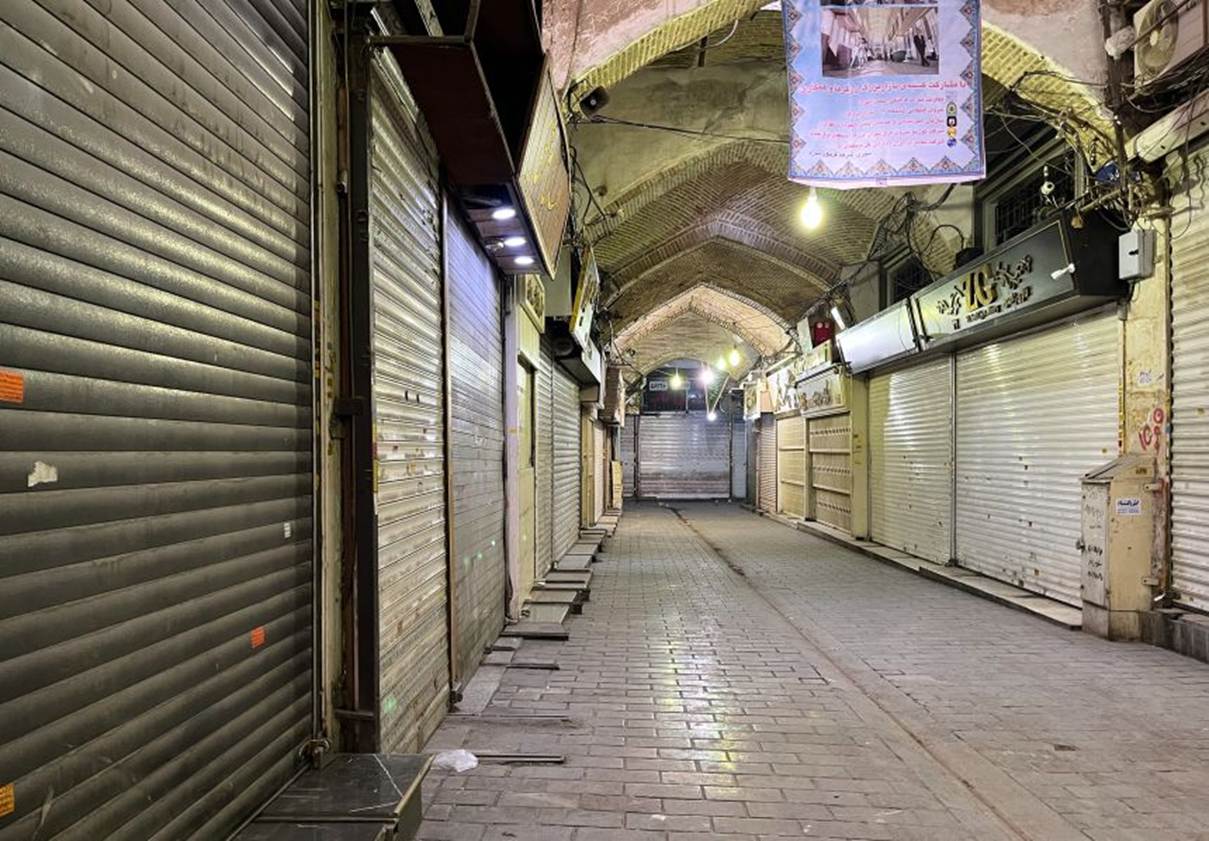
When shopkeepers in the narrow streets of Tehran’s Grand Bazaar protested the government’s failing economic policies last week, their chants rattled the regime.
Exacerbating the situation, the central bank decided last week to end a program allowing some importers to access cheaper US dollars compared to the rest of the market — a decision that led shopkeepers to increase prices.
Prices of basic goods like cooking oil and chicken dramatically spiked overnight, and some products vanished all together. The volatility pushed the bazaaris to close shop, a drastic measure for a group traditionally supportive of the Islamic Republic.
After days of protests and crackdowns, the reformist-ruled government attempted to alleviate the pressure by offering direct cash handouts of almost $7 per month, although it said at the same time that this measure alone could not solve the crisis.
“We should not expect the government to handle all of this alone,” President Masoud Pezeshkian said in a televised speech Monday.
How big are the protests now?
Iranian provinces as far west as Ilam, a Kurdish-majority region bordering Iraq, and Lorestan, have emerged as restive hot spots. Fueled by ethnic division and poverty, crowds set fires in the streets and chanted “Death to Khamenei,” directly challenging Iran’s supreme leader, Ayatollah Ali Khamenei, who holds ultimate authority over the nation’s religious and state affairs.
Video geolocated by CNN to a public square in Mazandaran provice in Iran’s far north shows a large crowd of protesters calling for the removal of Khamenei.
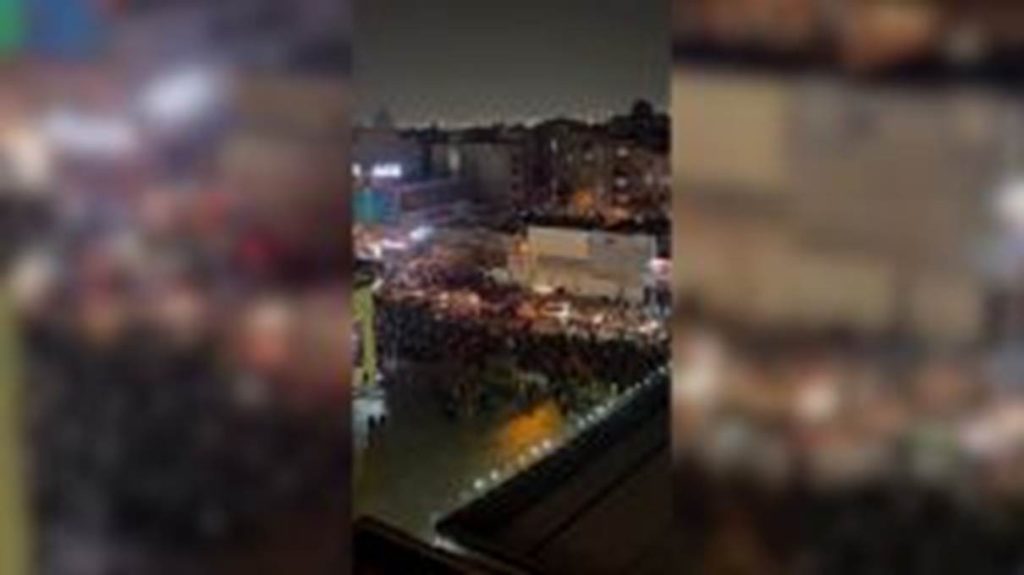
“This is the year of blood,” they chant, “Seyyed Ali (Khamenei) is going to fall.”
Another piece of footage, also geolocated, shows a fire raging inside a government complex in Golestan province.
In video distributed by Reuters, demonstrators in the northeastern city of Mashhad — Iran’s second-largest and Khamenei’s hometown — lowered and tore apart an Iranian flag.
Protesters in Mashhad, Iran lowered the national flag before tearing it apart, as seen in social media video distributed by Reuters. Social Media via Reuters
The city of Ilam, capital of the province of the same name, became a focal point this week after wounded protesters were taken to a hospital, only for security forces to subsequently raid the facility and arrest them in an incident that sparked widespread condemnation from human rights groups and prompted the government to promise an investigation.
Iranian state-affiliated Fars News Agency said 950 police officers and 60 personnel from the paramilitary Basij force have been injured in the protests, mostly in confrontations in western provinces with “rioters” who were “equipped with firearms, grenades and weapons.”
People in more than 100 cities have taken to the streets since demonstrations began 11 days ago, including the capital, Tehran.
At least 45 protesters, including eight children under the age of 18, have been killed in the first 12 days of ongoing nationwide protests in Iran, the Norway-based Iran Human Rights NGO (IHRNGO) reported Thursday. It said hundreds more have been injured and over 2,000 people detained since demonstrations began on December 28, 2025.
“State forces have used live ammunition to suppress the protests and have carried out widespread, mass arrests in some cities,” IHRNGO said.
Iranian news outlets reported Thursday that at least five security personnel have also been killed in the unrest, including two members of Iran’s Islamic Revolutionary Guard Corps.
CNN could not independently verify the numbers of those killed and arrested, and Iranian state news organizations have sometimes reported individual deaths without providing a comprehensive tally.
In video from Tabriz released by IranWire, shots could be heard in the background as protesters walked on a roadway. It was unclear whether the shots were from authorities using live rounds, and the source of the shots was out of frame.
Alp Toker, director of cybersecurity watchdog NetBlocks, told CNN that despite the internet and phone blackout, some Iranians have been able to access wifi by using “contraband terminal equipment” to connect to Starlink.
“National blackouts tend to be the regime’s go-to strategy when deadly force is about to get used against protesters,” Toker said, “with the goal being to prevent the spread of news of what’s happening on ground, and also to limit international scrutiny.”
How are protests different this time?
The ongoing protests are the biggest since the large-scale and deadly protests that were sparked by the death of 22-year-old Mahsa Amini while in the custody of the religious police in 2022.
This time, the bazaaris, a powerful force for change in Iran’s history and one that is seen as loyal to the regime, began the protests.
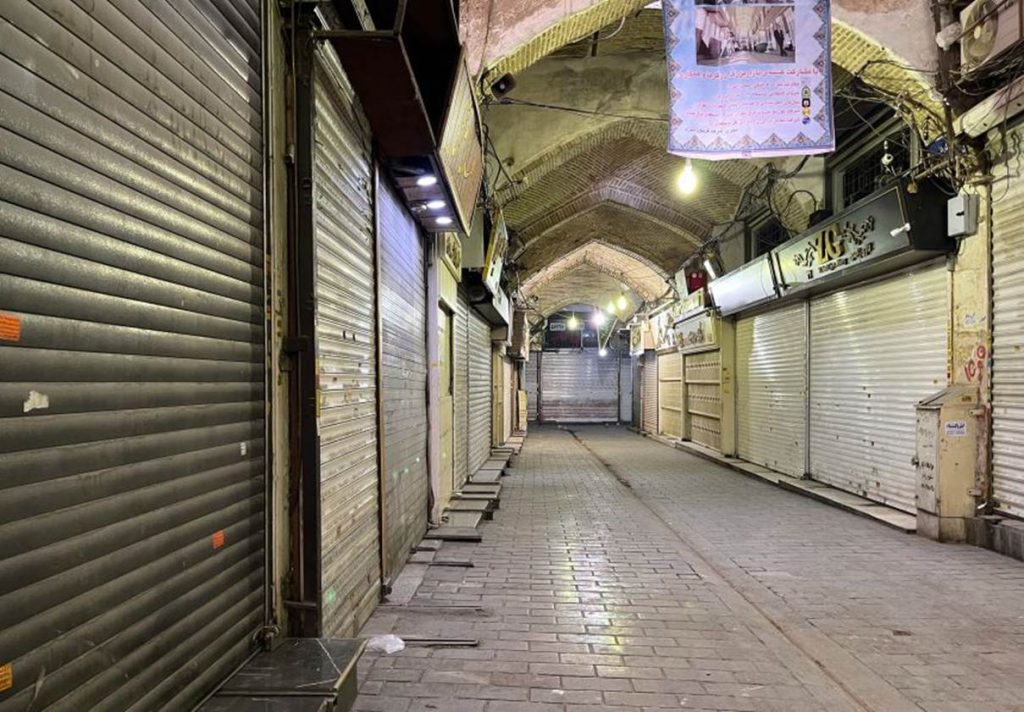
Shops are closed during protests in Tehran’s centuries-old main bazaar in Iran on January 6.
Vahid Salemi/AP
In an enduring alliance between the bazaaris and the Shiite Muslim clergy in Iran, the shopkeepers have played a crucial role as kingmakers across Iran’s history. It was their support for those very clergymen that eventually helped the Islamic Revolution of 1979 succeed, giving the rebels a financial backbone that led to the fall of Shah Mohammad Reza Pahlavi and, with it, the collapse of Iran’s 2,500-year-old monarchy.
The current protests also take place under rising foreign threats. Just six months ago, Israel and the United States launched attacks on Iran for the first time, with Trump raising the prospect of new attacks last week, just days after meeting Israeli Prime Minister Benjamin Netanyahu.
What does it mean for the regime?
During his campaign, Pezeshkian positioned himself as a champion of the working class, promising economic relief through reduced government intervention in the currency market while also blaming US sanctions, corruption and excessive money printing.
But corruption across all parts of government, mismanagement of funds and the convergence of environmental problems and stagnant leadership have the government on the brink.
More than a year after he was voted in, the very working class he vowed to protect and the middle class that forms the backbone of the Iranian society are struggling.
External factors such as crippling sanctions and a potential new war with the United States and Israel have left the state paranoid and the population anxious.
The ongoing protests are the biggest public challenge to the regime since the 12-day war with Israel in June. And since Iranians demonstrated against the killing of Amini, the young woman who was arrested for not abiding by the official dress code, the state now struggles to provide any tangible steps that could prevent eventual complete dysfunction.
Experts say that without a viable alternative to the current ruling system, protests are unlikely to instigate regime change, yet the widespread unrest underscores the profound crises confronting Iran’s government.
“None of Iran’s political leaders have a blueprint to get Iran out the crises,” Arang Keshavarzian, an associate professor of Middle Eastern and Islamic studies at New York University, told CNN.
“The only tool that the Islamic Republic truly has left is coercion and force. People have tried different methods to air their views,” he added. “But over the past 15 years, large segments of the population have lost trust in the regime and don’t believe they are able and willing to actually listen to them and address their grievances and interests,” he said.
CNN’s Mohammed Tawfeeq, Max Saltman, Avery Schmitz and Gianluca Mezzofiore contributed to this report.