Climate. Six months after Hurricane Melissa: sustaining recovery under compounding constraints in Cuba
Good morning, greetings from Panama.
Six months ago, Hurricane Melissa made landfall in coastal and fishing communities across eastern Cuba, affecting more than 2 million people and leaving widespread destruction, particularly in Santiago de Cuba, Granma, and Holguín.
The storm destroyed hundreds of thousands of homes, affected more than seven hundred health facilities, and severely disrupted water systems, with nearly one hundred pumping stations impacted. Entire communities were left without reliable access to electricity, clean water, or basic services, and recovery has been slow and uneven.
The IFRC and the Cuban Red Cross have decades of experience responding to hurricanes in the country—including Ian, Sandy, Matthew, and Irma. But few operations have been as logistically complex as this one.
The response to Hurricane Melissa has taken place in the context of a prolonged arboviral epidemic, placing additional pressure on already strained health systems, and more recently, under severe energy constraints that are directly affecting the continuity of humanitarian and essential services.
Across the country, fuel shortages and instability in the electricity grid have been disrupting transport, water systems, waste collection, and the delivery of health services. These are not secondary challenges—they are defining the conditions for recovery and resilience.
For communities affected by the hurricane, this means that progress is fragile. Homes remain roofless or severely damaged, access to clean water is uneven, and health risks persist—even as cases of dengue and chikungunya begin to decline.
For the Cuban Red Cross, it means operating in an environment where every activity—from distributing relief to supporting health services—depends on access to energy.
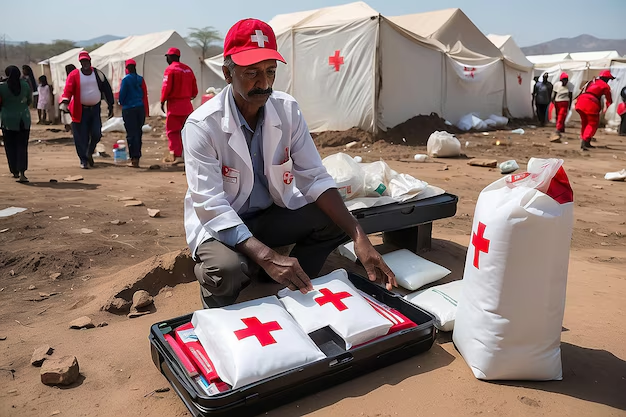
In the immediate aftermath of the hurricane, the IFRC launched an Emergency Appeal to support one hundred thousand people over two years. Although the appeal remains significantly underfunded, it has enabled us to support the Cuban Red Cross in assisting nearly 45,000 people with essential services, psychosocial support, and relief items, including hygiene kits, mosquito nets, and shelter materials.
The water systems installed by our volunteers in affected communities have already provided millions of liters of safe water, supporting up to 30,000 people each week. Health services, disease prevention activities, and community-based support continue across the most affected provinces.
Six months on, the challenge is no longer only to respond—it is to sustain.
To prevent recovery from stalling, the IFRC and the Cuban Red Cross have strengthened their operational approach to safeguard the minimum functionality of essential services.
We have secured fuel access for Cuban Red Cross vehicles, dispatched the first photovoltaic systems and electric vehicles to the country, and are progressing with the procurement of roofing materials for damaged homes, which will be delivered as soon as possible in Cuba.
I had the opportunity to visit Havana a few weeks ago. The need to address energy, sanitation, and transport challenges is clear—but so is the commitment of Red Cross volunteers and technical teams. In coordination with public institutions and key humanitarian actors, they remain active in eastern Cuba—and across the country—distributing assistance as it becomes available and preparing for the upcoming hurricane season.
It is truly remarkable to witness how more than 40,000 volunteers across the country remain consistently available to support their communities, preparing for and responding not only to hurricanes, but also to disease outbreaks and other risks present nationwide.
We call on the international community to support this effort—not only to meet immediate needs, but to ensure THAT essential services remain accessible, and that recovery can continue with dignity and predictability.
Thank you.
International Federation of Red Cross and Red Crescent Societies